Introduction
One of the most common purchase decisions in India is whether to pay for a product upfront or convert the payment into monthly instalments. Both options have clear advantages, and the right choice depends on your financial situation, the product price, and the available offers.
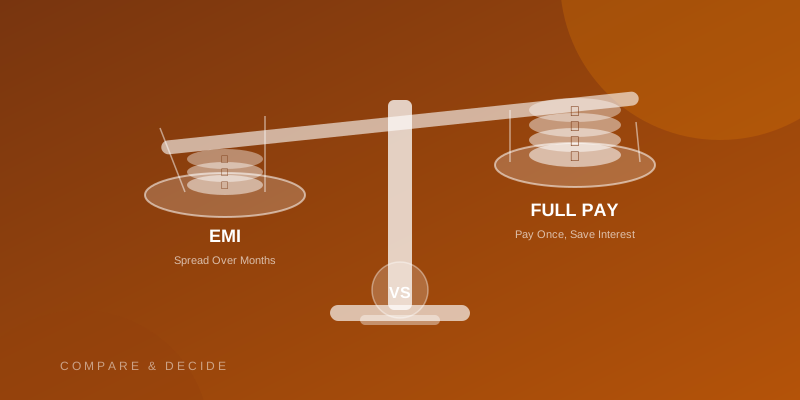
This guide explains the trade-offs between full payment and EMI so you can make an informed decision.
Benefits Of Paying Upfront
1. Lowest Total Cost
Paying the full amount in one go means you do not pay any interest, processing fees, or GST on those charges. The total cost equals the product price.
2. Better Negotiation Leverage
Sellers often offer a flat cash discount for upfront payment. This discount may be more valuable than any No Cost EMI offer, because the discount is applied to the entire price.
3. No Long-Term Obligation
Once paid, the product is fully yours. There is no future commitment, no risk of foreclosure charges, and no impact on your credit report.
4. Better For High-Value Items
For large purchases like a laptop, TV, or refrigerator, paying upfront avoids months or years of monthly outgo from your account.
Benefits Of EMI
1. Affordability
EMI lets you buy a product now and pay over several months. This is useful when the product is essential but paying the full amount would strain your monthly budget.
2. Liquidity Preservation
Paying through EMI leaves your savings intact. You can keep your emergency fund, invest the remaining cash, or use it for other priorities.
3. Predictable Cash Flow
Fixed monthly instalments make budgeting easier. You know exactly how much will leave your account each month.
4. Builds Credit History
Timely EMI payments are reported to credit bureaus and can help improve your credit score over time.
5. Useful For Big-Ticket Items
For purchases like phones, laptops, or appliances, EMI lets you upgrade without waiting months to save the full amount.
Decision Factors
Compare The Effective Cost
The simplest way to choose is to compute the effective cost of each option:
- Full payment — Use the price after any cash discount.
- Standard EMI — Use an EMI calculator to find total interest plus fees plus GST.
- No Cost EMI — Use a No Cost EMI calculator to add up the processing fees, GST, and any cashback.
If the effective cost of EMI is more than the upfront price after discount, full payment wins.
Check Your Cash Flow
If paying upfront would deplete your emergency fund or leave you with little liquidity, EMI may be the safer option even if it costs a little more.
Look At The Tenure
Short tenures (3 to 6 months) typically cost less in interest than long tenures (12 to 24 months). If EMI is necessary, prefer the shortest tenure you can afford.
Consider Cashback Offers
Sometimes, paying through a specific credit card gives you a cashback that effectively discounts the product more than the interest charged. Run the numbers using the Effective Cost Calculator.
Example Scenarios
Scenario 1: Budget Phone Purchase
A smartphone is priced at ₹25,000.
- Full payment with 5% cash discount: ₹23,750 total.
- 6-month No Cost EMI with ₹250 processing fee + 18% GST: ₹25,295 total.
Decision: Pay upfront. The effective cost is lower.
Scenario 2: High-Value Laptop Purchase
A laptop is priced at ₹1,20,000.
- Full payment: ₹1,20,000 (no discount available).
- 12-month standard EMI at 14% interest: ₹1,20,000 + ~₹9,300 interest + ~₹500 fee.
Decision: If you have the cash saved, full payment saves interest. If not, prefer No Cost EMI with the lowest processing fee.
Scenario 3: Essential Appliance With Cashback
A refrigerator is priced at ₹45,000.
- Full payment: ₹45,000.
- EMI on credit card with 10% cashback: ₹45,000 EMI minus ₹4,500 cashback = ₹40,500 effective cost.
Decision: Use the credit card EMI. The cashback more than offsets any interest.
Related Calculators
Related Guides
Disclaimer
This guide is for educational purposes only and does not constitute financial advice. Effective costs, discounts, and EMI terms vary by retailer, bank, and product. Always verify the actual terms of the offer with the seller and your bank before making a purchase decision.