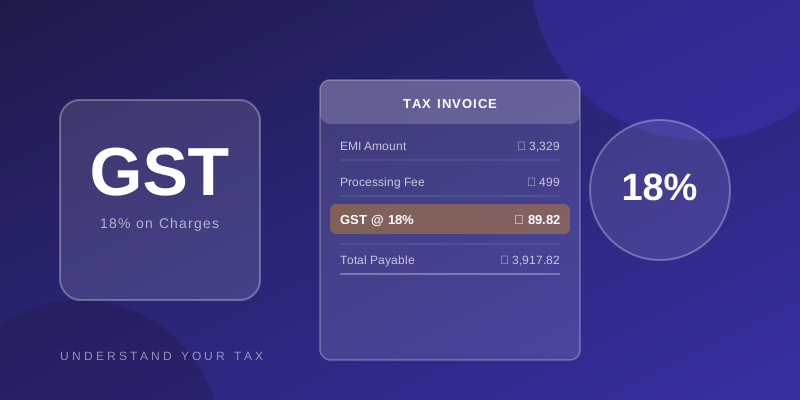
Introduction
Goods and Services Tax (GST) is an indirect tax applied to most financial services in India, including charges related to EMI. Many buyers are surprised to learn that GST applies to processing fees, foreclosure charges, and in some interpretations, the interest component of an EMI.
This guide explains when and how GST is applied to EMI-related charges, and how to factor it into your cost calculation.
GST Applicability
GST is applied to the following EMI-related charges at the rate of 18%:
- Processing fees
- Documentation fees
- Foreclosure charges
- Late payment fees
- Other service charges levied by the bank or NBFC
The GST is calculated on the base charge and added on top. The bank collects the GST and remits it to the government.
Common Charges And GST Treatment
Processing Fee
A flat or percentage-based fee charged when the EMI is set up. GST at 18% applies on the full processing fee.
For example, a ₹500 processing fee attracts ₹90 GST, bringing the total to ₹590.
Interest Component
The treatment of GST on interest is more nuanced:
- Standard EMI — Historically, GST did not apply to the interest component of a loan because interest is considered a consideration for time value of money. However, banks and NBFCs may levy GST on certain fees and charges.
- No Cost EMI — Under GST rules, when a merchant offers a discount to the bank to enable No Cost EMI, the underlying supply may be treated differently. Consult a tax advisor for specifics.
Foreclosure Charges
If you close the EMI before the end of the tenure, the bank may charge a foreclosure fee. GST at 18% applies to this fee.
Late Payment Fee
If you miss an EMI payment, the bank charges a late fee. GST at 18% applies to this fee as well.
Calculation Examples
Example 1: Processing Fee Only
A 12-month EMI is set up on a product priced at ₹50,000.
| Component | Amount |
|---|---|
| Processing Fee | ₹500 |
| GST on Fee (18%) | ₹90 |
| Total One-Time Charge | ₹590 |
Example 2: Foreclosure
You close a 12-month EMI after 6 months. The bank charges 2% of the outstanding principal as foreclosure fee.
| Component | Amount |
|---|---|
| Outstanding Principal | ₹26,000 |
| Foreclosure Fee (2%) | ₹520 |
| GST on Fee (18%) | ₹93.60 |
| Total Foreclosure Cost | ₹613.60 |
Example 3: Late Payment
You miss an EMI payment and the bank charges a ₹450 late fee.
| Component | Amount |
|---|---|
| Late Payment Fee | ₹450 |
| GST on Fee (18%) | ₹81 |
| Total Late Fee | ₹531 |
How GST Is Disclosed
Banks disclose GST as a separate line item on the credit card statement or loan statement. It is usually mentioned as “GST @ 18%” next to the corresponding charge.
For credit card EMI, the GST is typically added in the same statement cycle as the processing fee or late fee.
Common Misconceptions
”GST applies to the entire EMI amount”
GST does not apply to the principal or to the interest component of a standard EMI. It applies only to specific fees and charges.
”No Cost EMI is GST-free”
No Cost EMI may still attract GST on the processing fee. The “no cost” refers to the interest component, not the service charges.
”Banks pocket the GST”
Banks collect GST only on behalf of the government and remit it to the GST department. They do not retain this amount as income.
Impact On Effective Cost
For most EMI purchases, GST adds a small percentage to the total cost. However, in some cases, GST can push a No Cost EMI above the upfront price.
For example:
- Upfront price: ₹40,000
- No Cost EMI with ₹500 fee + 18% GST: ₹40,590
- Effective premium: ₹590 (about 1.5%)
If the merchant offers a cash discount of more than 1.5% on upfront payment, paying upfront is cheaper.
How To Account For GST In Calculations
When using the Effective Cost Calculator, include GST on fees as a separate input. Most calculators do this automatically when the fee is entered.
For a quick mental calculation:
- Add 18% to any processing fee to get the total one-time charge.
- Compare the total one-time charge to the discount available on upfront payment.
Related Calculators
Related Guides
- Understanding Processing Fees
- What Is No Cost EMI
- How To Calculate Effective Cost
- Common EMI Mistakes
Disclaimer
This guide is for educational purposes only and does not constitute tax, legal, or financial advice. GST rates, applicability, and disclosure requirements are subject to change based on government regulations. Always verify the actual charges with your bank and consult a qualified tax advisor for advice specific to your situation.