Introduction
A processing fee is a one-time charge levied by a bank or NBFC when you set up an EMI on a credit card or loan. It is charged in addition to the interest component and is one of the most overlooked costs of buying on EMI.
Even on a No Cost EMI, where the interest component is supposedly zero, the processing fee is almost always applicable. This makes the fee the single most important hidden cost to understand.
What Is A Processing Fee
A processing fee is a flat or percentage-based charge applied by the bank for:
- Verifying your credit card or loan eligibility
- Setting up the EMI plan in their system
- Allocating the funds to the merchant
- Generating the EMI schedule and billing it to your account
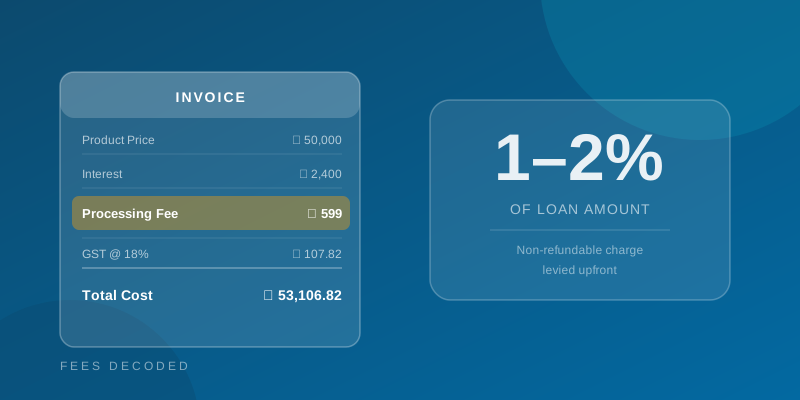
Typical processing fees in India range from ₹199 to ₹999 for credit card EMI, and from 1% to 3% of the loan amount for personal loans and consumer durable loans.
Why Banks Charge Them
Banks and NBFCs charge processing fees to cover the operational cost of:
- Underwriting the loan
- Compliance with RBI regulations
- Customer onboarding and KYC verification
- IT and back-office infrastructure
For No Cost EMI specifically, the bank is also doing extra work to coordinate the discount with the merchant. The processing fee offsets that administrative cost.
Impact On Savings
The processing fee is small in absolute terms, but it can substantially change the effective cost of a No Cost EMI.
Consider a No Cost EMI of ₹50,000 over 12 months:
| Component | Amount |
|---|---|
| Product Price | ₹50,000 |
| Interest (No Cost EMI) | ₹0 |
| Processing Fee | ₹500 |
| GST on Fee (18%) | ₹90 |
| Total Cost | ₹50,590 |
The fee and GST add ₹590 to the cost. While this is small relative to the price, it means the purchase is no longer truly “no cost.”
How Processing Fees Are Disclosed
Banks are required to disclose the processing fee at the time of EMI conversion. The disclosure usually appears:
- On the EMI conversion page in net banking or mobile banking apps
- In the EMI schedule sent by SMS or email
- In the first credit card statement that includes the EMI
The fee is typically added to the first EMI or to the principal of the loan, depending on the bank.
Common Fee Ranges
Different EMI types carry different processing fee ranges:
- Credit card EMI on e-commerce — ₹199 to ₹599
- Credit card EMI at retail outlets — ₹299 to ₹999
- Consumer durable loan — 1% to 2% of the product price
- Personal loan — 1% to 3% of the loan amount
- No Cost EMI — Often higher than standard EMI, since the bank needs to recover its administration cost without interest income
Hidden Costs
A few additional charges that look like processing fees but are not:
Documentation Fee
Some lenders charge a separate documentation fee. This is rare for credit card EMI but common for personal loans and consumer durable loans.
Insurance Premium
Some banks add an insurance premium to the loan amount, marketed as a way to protect the borrower’s family in case of an event. This is optional in most cases and can be refused.
Convenience Fee
For online transactions, a convenience fee may be charged by the merchant or the payment gateway. This is separate from the bank’s processing fee.
How To Minimise Processing Fees
There is no way to avoid a processing fee entirely, but you can minimise it:
- Compare offers across banks — Some banks offer zero processing fees during festive sales.
- Negotiate with the merchant — Large purchases at offline retailers sometimes allow fee waivers.
- Use a credit card with fee waivers — Some premium cards offer EMI fee waivers as a benefit.
- Pay in full if the fee makes EMI more expensive — If the effective cost of EMI exceeds the upfront price, skip EMI entirely.
Example
Consider a smartphone priced at ₹30,000:
| Option | Effective Cost |
|---|---|
| Upfront payment (no offer) | ₹30,000 |
| 6-month No Cost EMI with ₹300 fee + 18% GST | ₹30,354 |
| 6-month No Cost EMI with fee waived (festive offer) | ₹30,000 |
The fee waiver makes the EMI truly “no cost” only if the merchant or bank specifically waives it. Otherwise, the EMI option adds a small but real cost.
Related Calculators
Related Guides
Disclaimer
This guide is for educational purposes only and does not constitute financial advice. Processing fee amounts and waivers vary by bank, card type, and merchant. Always verify the actual fee disclosed by your bank at the time of EMI conversion before confirming the transaction.